About

In partnership with Institut Français, Sonali Bhagchandani was the recipient of a one-month residency at Chateau La Napoule, the residency space of the La Napoule Art Foundation, where she conceptualised this project.

Sonali Bhagchandani is a writer and curator based in Mumbai, India. Her research explores both visual and narrative strategies in story-telling, focusing on intersections between text, image, and the ‘archive’ in contemporary exhibitions and material histories. She holds an MA in History from Goldsmiths, University of London (2022), and a BA in English Literature from St. Xavier’s College (2016). Previously, she attained a Post Graduate Diploma in Modern & Contemporary Indian Art and Curatorial Studies from the Dr. Bhau Daji Lad Museum, Mumbai (2017). Her writings have been published by Project 88, ART India, The Hindu, JPM Quarterly, and Usawa Literary Review.

Art Scribes Award

Designed as an annual art writer’s award, an eminent, rotating jury consisting of art critics and curators is assigned the task of choosing an applicant who has demonstrated a sustained commitment to research, conceptual frameworks and art history in their writing practice, as the recipient of the award. Applications are received via open call as opposed to nominations to ensure equal opportunity.

The chosen writer is awarded an international curatorial residency in partnership with our various collaborators around the world in order to help them demonstrate their critical acumen in curatorial research. This is part of PRAF’s emphasis on encouraging research, criticality and innovation within curatorial narratives, especially among young/emerging curators.

Art scribes award is now in its 12th edition, and since last year it has been under the framework of the Villa Swagatam residencies of Institut Français in India. Sonali Bhagchandani was awarded a one-month residency at Chateau La Napoule, the residency space of the La Napoule Art Foundation, where she conceptualised this project. The Art Scribes award is realised with the support of our partners La Napoule Art Foundation, Institut Français and Ambassade De France en Inde, and our knowledge partner Devi Art Foundation.

French Institute in India

French Institute in India as an institutional partner collaborates with the Art Scribes award by helping the award  develop partnerships internationally and advises the residency program based on the research interests of the  recipient of the award.

La Napoule Art Foundation

Marie Clews founded La Napoule Art Foundation in 1951 in memory of her husband, a prolific sculptor. It was her  dream to create an international center for the arts at the Château that would promote cultural exchange and  understanding. For over sixty years, LNAF has hosted performances, residencies and exhibitions at the Château de  La Napoule by artists the world over. La Napoule Art Foundation offers time and space for creative minds to engage  in cultural interchange and meaningful work that impacts the world of the common good.

Devi Art Foundation 

In 2005, Devi Art Foundation was born out of a desire to facilitate the viewership of creative expression and artistic  practice. At the core of it is a contemporary art collection from India and other parts of South Asia. By presenting art  from all over the subcontinent, the Foundation hopes to invoke a sense of shared history within the region. It is  envisioned that the Collection will enable wider audiences to interact with cutting edge and experimental Artworks.  Continuing Traditions of Arts from India, also finds a substantial representation in the collection of Devi Art  Foundation.

Villa Swagatam

Villa Swagatam is a dynamic network of residencies designed to foster cultural exchanges between France, India, and the South Asia region. Encompassing a diverse range of artistic disciplines, with a particular emphasis on literature and arts and crafts, it facilitates exchanges in both directions: French creators journeying to India and Bangladesh and Indian creators venturing to France, forging partnerships with almost 30 prestigious residencies. Among them and in collaboration with Art Scribes Award, La Napoule Art Foundation is a dedicated to critical writing and curatorial practice.

Villa Swagatam is a program supported by the French Embassy and the French Institute in India.

Curatorial Note

A linearity holds our archival imaginary hostage: time (and memory) is often presupposed to be sequential, (pre)determined, calendrical – and thus contained inside records that appear stable. Such documents claim a material authenticity: dissolved of doubt, hesitation, emotion, or any recursive movement. Fraught landscapes are flattened into abstracted statistics, as historical time accrues in the form of a ‘memorial’. Here, data collates and multiplies to no definite end; an ‘archive fever’ now subsumes our contemporary discourse. But if we take a step back, can such a linear apparatus truly harbour the weight of memory, or capture the movement of time? Put differently, can temporality be restricted to a linear chronology? Is our relation to the past – with our flawed, incomplete subjectivities – itself an objective phenomenon? For even if we remember (or document) with precision, historical narratives tend to slip, mutate, or turn delinquent – at times, morphing to strengthen the agenda of hegemonic regimes. 

At this tenuous impasse, could a perspectival shift – a squint, a twist, or a slant of sorts – open up a newer way of seeing and capturing time, to revive its radical historicity? What might this look like? Marking a departure from linearity, Walter Benjamin once likened a historian to a storyteller: where grasping the past does not mean reconstructing it “the way it really was” back then, but rather, reckoning with its disjointed temporal remnants in our contemporary – to capture a “memory as it flashes up in a moment of danger.” Time is split, transient, and urgent – untethered from the calendar. How might memory collect (and archive) such a fleeting temporality, and more importantly, what are the political stakes of these conceptual movements? Resisting a positivist approach, this exhibition proposes a subtractive twist into our archival imaginary: each artwork takes a slant, piercing into our hitherto stagnant temporality; and at this unsettling edge, one encounters the gaps, slippages, absences, and contingencies immanent in the making (and re-making) of history. Each narrative necessitates an unlearning of the present in order to grasp the past.

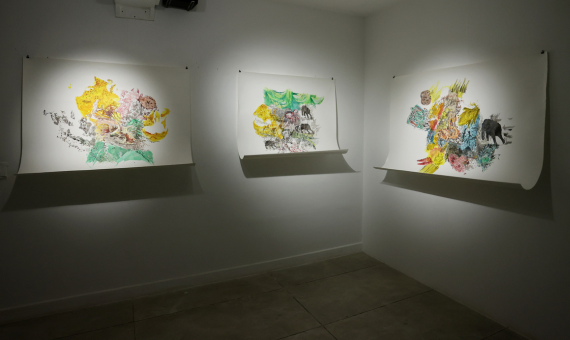
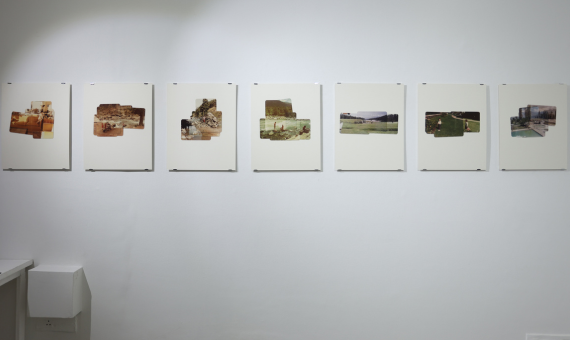
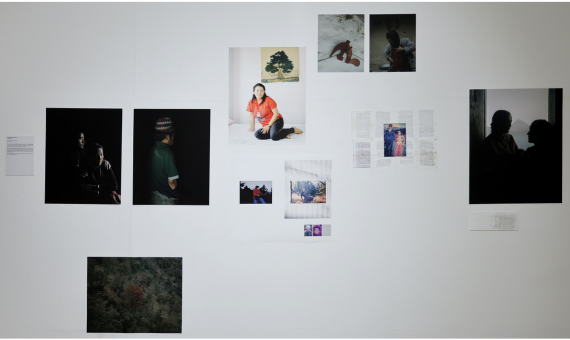
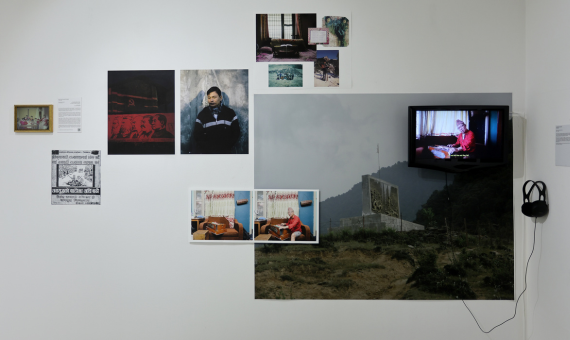
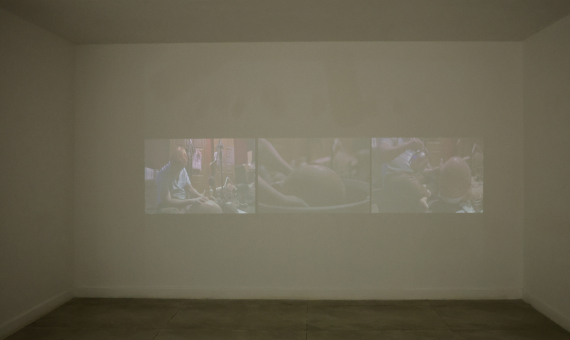
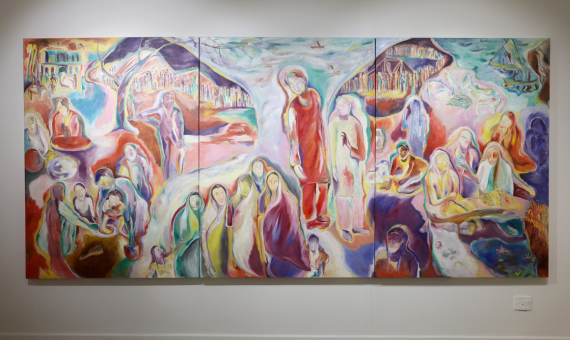
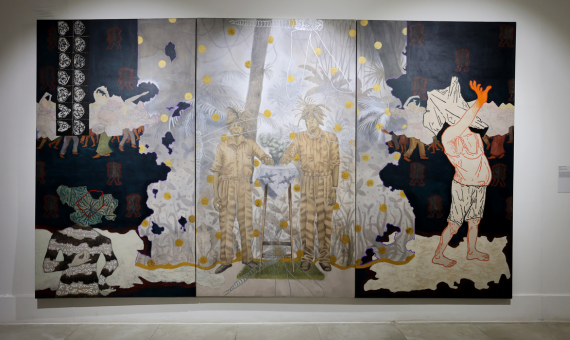
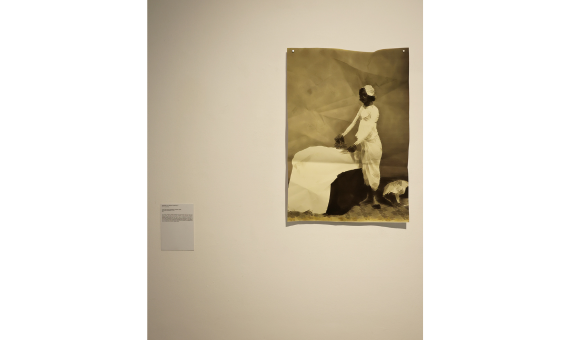
Fiction and phantoms no longer dilute an ‘objective’ truth, but rather, become portals to grasp our unspoken desires, unrealised dreams, and the inscrutable (yet inexhaustible) core of language. As memory sheds any façade of objectivity – the canonical ‘unstained’ knowledge – you encounter the ruins of time, a structural exoskeleton that bears the imprint of potential, the conditions of possibility to create anew. Out here, viewers confront family archives that index an ode to forgetfulness; phantoms of abandoned archives that return in spectral formations, interrupting the present; tense slippages between aural, visual, and textual registers of silent testimonies that tremble cartographic lines; a long Partition’s fearful relation to belonging, resisting temporal frameworks; the symbolic (and sonic) remnants of a forgotten revolution in Nepal; and the outtakes of a film from the 1980s, resurrected into a haunting ghost-like spectre of sectarian violence. These juxtapositions render our ordinary ground estranged, unstable, and on the move. In short-circuiting our archival imaginary, this exhibition is an experiment: to create speculative nodes where the tropes of memory can be reconfigured. From more than a century ago, Emily Dickinson’s words become our manifesto: “Tell all the truth but tell it slant.”